
OneAM Turns Two: Reinventing Working Capital for Small Businesses
By: Ksusha McCormick, Chief Executive Officer
Published April 8, 2026 | Estimated read time: 2 min
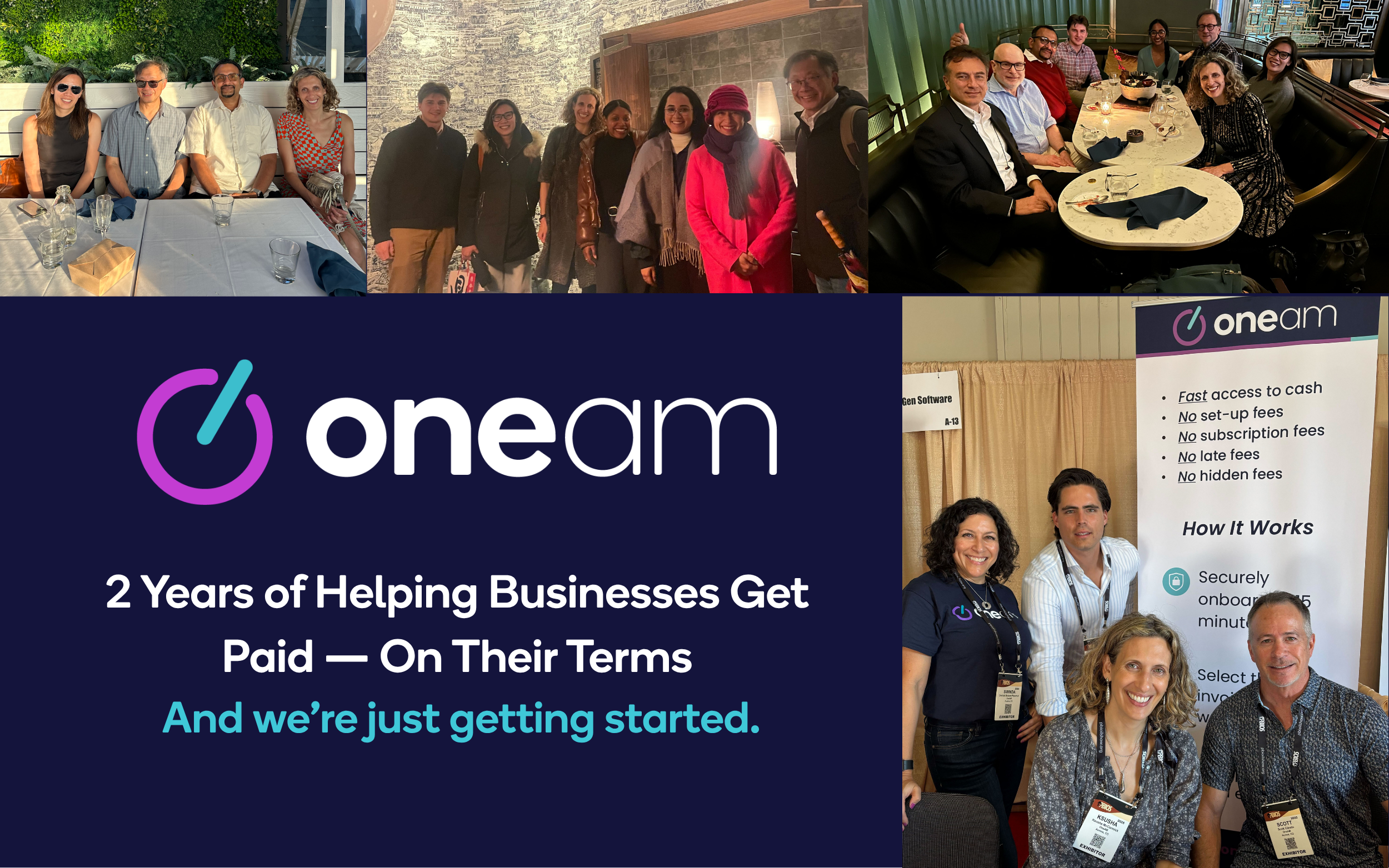
This month marks the two-year anniversary of OneAM. Building a startup can feel like a never-ending sprint, uphill, on cross-country skis, bearing a backpack full of gear. But reaching this milestone is a good opportunity to take a deep breath, celebrate a bit, and review the journey so far. In this spirit, we’re sharing some of what we’ve learned along the way.
What Didn’t Surprise Us
When Charlotte and I founded OneAM, we chose to focus on a narrowly defined but massive slice of the US economy – small and midsize businesses with large end customers. By our estimates, the invoicing volume of this segment is $4.5T annually. It was our belief that these 300,000+ American businesses face unique challenges and pain points. The payment terms of their end customers tend to be long, and they’re getting ever longer. As small vendors to large corporates, these businesses have almost no leverage to negotiate better terms. Meanwhile, they are squeezed on the payables side either by suppliers who themselves are large and demanding, or by the necessities of making payroll and keeping the business afloat.
These businesses are often too small to obtain low-cost funding from banks, but too big and too price sensitive to be a fit for fintech financing, most of which is geared towards consumers or micro-SMBs. What these businesses need is simple: easy, flexible, business-friendly, and reasonably priced working capital. Delivering this solution in a scalable way is in fact quite complex, but we knew that if we could figure it out, we would encounter a lot of demand for our product.
What Did Surprise Us
Two years ago, we thought that most of the demand would come from sectors that are currently dominated by factoring: automotive, construction, oil & gas, and retail. What we didn’t expect was the enthusiastic response from just about every corner of the US economy. As we came to discover, large, publicly traded corporates face similar pressures and incentives regardless of industry. During times of stress, they tend to hold on to their cash, shoring up reserves so that they can boost quarterly earnings, take on a bigger debt load, spend money on M&A or simply weather economic shocks brought on by supply chain disruptions, tariffs, or geopolitical uncertainty. The large corporates’ hunger for cash can leave their small suppliers starved of options for addressing their own cash needs, creating a working capital pain point just about everywhere.
Looking Ahead
One of the things that we couldn’t fully appreciate when we launched was the speed with which advances in technology would change the landscape, both for businesses and for capital providers. On the small and medium business side, AI has lowered the costs of starting and running a business. The speed of innovation (as well as the fear of missing out) means that large corporates are more willing than ever to work with small, nimble, specialized vendors. As a result, we believe that the need for working capital solutions that don’t depend on the goodwill of a large payor will only grow in the coming years.
On the capital side, AI tools have turbocharged the availability and usability of data. Financing a large number of small B2B receivables has to be quantitative in order to be efficient, but legacy providers such as factors, banks, and even most private credit funds are not operationally set up to take advantage of the new and better tools. As banks remain confined by regulation and private credit suffers through a spike in redemptions, we see sophisticated capital providers starting to invest in what they regard as a large and inefficient asset class.
The Secret Sauce
When we started OneAM, Charlotte and I knew that regardless of how big the addressable market might be or how good we thought our idea was, the success of our business would hinge on one very simple thing: the people. Solving the SMB working capital gap problem means delivering a complex solution in an elegant and user-friendly wrapper to both sides of the equation – to the business owners and to the capital providers. It requires deep problem-solving skills and subject matter expertise across technology, quantitative portfolio management, payments infrastructure, legal, regulatory, and other domains. And if that wasn’t enough, it requires for the people who possess this expertise to want to work together, and to feel that working together is challenging, rewarding, and fun! As we start the third lap of this marathon, we are more excited than ever by our prospects and by the opportunity to bring a radically better early pay solution to the businesses that form the backbone of the US economy.